Iturin-Based Bio-Fungicide (Cyclic Lipopeptide Antifungal)
One-line positioning:
Iturishield delivers concentrated, fermentation-derived Iturin (iturinic lipopeptide) activity to suppress key fungal pathogens through direct membrane disruption + competitive colonization + induced plant defenses, while supporting residue-conscious, sustainable crop programs.
1) Why Iturin? (What “Iturin” actually is)
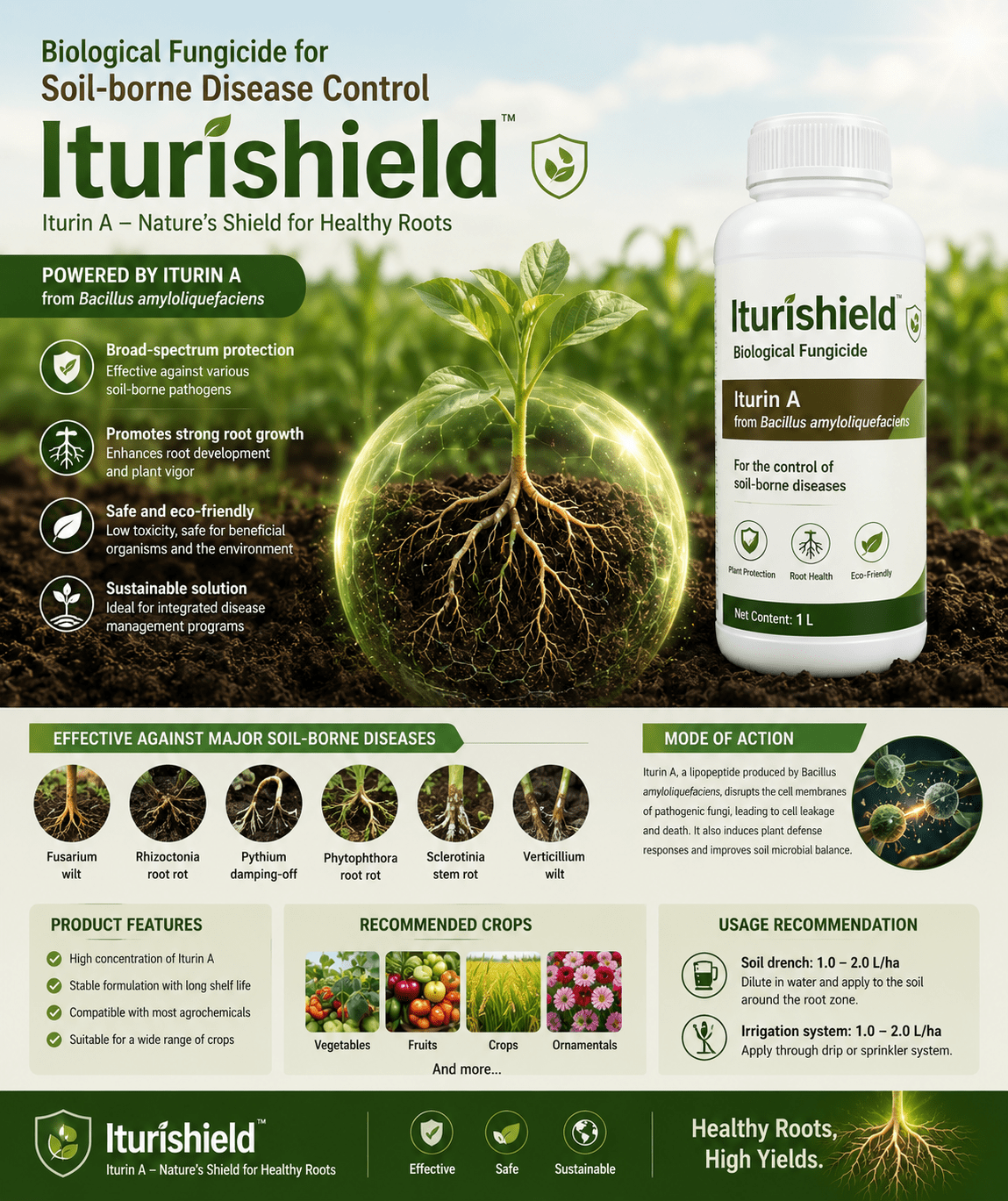
Iturin (often discussed as Iturin A and related iturinic cyclic lipopeptides) is a family of amphiphilic cyclic lipopeptides produced by beneficial Bacillusspecies (B. subtilis / B. amyloliquefaciens / B. velezensisgroup).
Structurally, it combines a hydrophobic β-amino fatty-acid tail with a cyclized heptapeptide ring, giving it strong membrane-active behavior — which is why it stands out compared to simple contact “bio extracts.”
In agronomic biocontrol, the value of Iturin isn’t just “it’s natural.” The value is how it acts:
-
Direct antifungal pressure (physical disruption of pathogen membranes)
-
Ecological competition (rapid colonization of rhizosphere / phyllosphere niches)
-
Plant health signaling (contributing to induced resistance pathways)
This makes iturishield
a good fit for IPM / resistance-management tanks where you want another mode of actionbeside single-site synthetics.
2) Mode of Action
A. Membrane-targeted antifungal action (core of Iturin’s efficacy)
Published mechanistic discussion of Iturin emphasizes that these lipopeptides can interact with fungal membrane components (e.g., ergosterol/lipids) and insert into membranes, promoting transmembrane pore-like disturbances that collapse membrane potential & ion gradients, leading to leakage of cellular contents and loss of homeostasis (and, in many reports, associated oxidative stress/ROS effects) — which together drive fungal cell dysfunction/death rather than a simple “contact burn.”
Plain-language for your customers:“Iturin doesn’t need to ‘poison’ a fungus the way many synthetics do — it destabilizes the fungal membrane architecture itself, so treated spores/conidia and young hyphae lose integrity and stop developing.”
B. Colonization & niche exclusion (the “living shield” part)
When delivered as a fermentation-basedproduct (not just purified molecule), the biomass/metabolite complex helps occupy infection courts (root surface, near-root zone, leaf micro-environment), out-competing pathogens for space and nutrients.
C. Induced defense support (ISR-adjacent effect)
Iturin-class compounds are also discussed in the literature as capable of modulating plant defense-related gene expression / oxidative stress responses, contributing to enhanced resilience in the plant’s toolkit (often framed as induced systemic resistance / priming in biocontrol narratives).
3) What it helps control (typical Iturin-sensitive pathogen groups)
Use the list below as educational/technical framing
|
Pathogen / Disease Complex
|
Common Examples
|
Where it matters
|
|---|---|---|
|
Fusarium (wilt, crown/root rot)
|
Fusarium oxysporum, F. graminearumand related spp.
|
Soil drench / root zone; sometimes seed treatment
|
|
Rhizoctonia (damping-off, sheath blight, wire stem)
|
Rhizoctonia solani
|
Seedbed, nursery, soil, lower stem
|
|
Pythium (damping-off, seedling blight)
|
Pythiumspp.
|
Propagation, greenhouse, early season
|
|
Botrytis (gray mold)
|
Botrytis cinerea
|
Foliar/cluster zone; protected culture
|
|
Powdery mildew / leaf-surface fungi
|
Erysiphe, Podosphaera, Leveillulaspp.
|
Foliar programs (preventive timing)
|
|
Anthracnose / Colletotrichum
|
Colletotrichumspp.
|
Fruits, vegetables, ornamentals
|
|
Postharvest decay fungi (storage rots)
|
Penicillium, Alternaria, Botrytis
|
Postharvest wash/dip or storage fog (where permitted)
|
(Many of these pathogen groups appear in Iturin/ Bacillus-lipopeptide biocontrol literature as sensitive targets.)
4) Application scenarios & program fit
Ideal use windows
-
Seed treatment / seed-coating (protect germination & early root zone)
-
Soil drench / drip chemigation (rhizosphere protection)
-
Foliar preventive sprays (especially for high-humidity / dense-canopy situations)
-
Postharvest aid (as allowed by your market & label)
How to position it in a program
-
Resistance-management: alternate or tank-mix only where label allowswith other MoA groups to diversify selection pressure.
-
IPM-friendly: because the primary punch is membrane-disruption + biology-driven competition, it is generally softer on beneficials than broad-spectrum synthetics — but always follow label re: pollinator contact.
Timing rule of thumb to write on the page:“Iturin works best preventively — establish protection beforeinfection windows peak (early vegetative stage, pre-bloom canopy closure, or immediately post-rain events).”
5) Stewardship & Tank-Mix Guidance (very important for credibility)
-
Compatibility: Do not mix with strongly alkaline materials, copper at high load, quats, or broad-spectrum bactericides/disinfectants unless your compatibility test & label say yes.
-
Order of addition (if you recommend tank-mixing):
-
Half-fill water → 2) Wettables/WPs → 3) iturishield
→ 4) Adjuvant (only if label allows) → top up.
-
-
Jar test every new combo (especially with fertilizers & certain metals).
-
Application gear: Rinse lines; avoid residual copper/sanitizer leftovers.
6) A “Science Box” put at the bottom
How the antifungal lipopeptide works in a sentenceIturin’s amphiphilic structure lets it associate with fungal membranes; by interacting with membrane lipids/sterols it can promote permeability disturbances and pore-like damage that dissipate membrane potential, cause leakage, and push fungal cells into irreversible stress — an action distinct from many single-site demethylation- or respiration-inhibitors growers use.